
5-Axis CNC Machining for Robotics Components
RobotPartsCNC provides custom 5-axis CNC machining for robotics, automation, motion control, and advanced mechanical systems. We manufacture complex robot joint housings, actuator housings, robotic arm components, output flanges, motor mounts, and lightweight structural parts from customer CAD models and drawings.
Based in Shenzhen, China, we support robotics startups, automation integrators, engineering teams, and established equipment manufacturers from first prototype through repeat production.
- Standard Tolerance
- ±0.01 mm
- Minimum Quantity
- From 1 pc
- Prototype Lead Time
- 3–7 days
- Surface Roughness
- Ra 0.4–3.2 μm
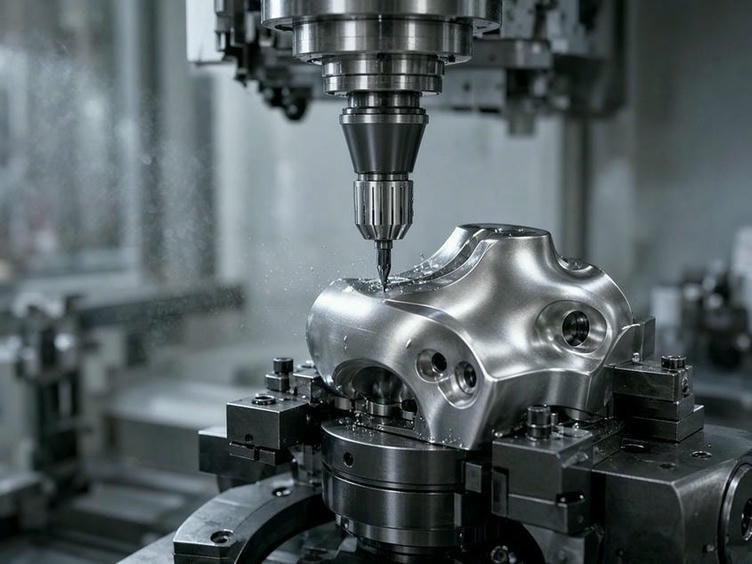
One-Setup Advantage
Multi-face features machined with fewer datum transfers and tighter positional control.
Complex Robotics Parts Machined in Fewer Setups
Robotic components often combine precision bores, mounting patterns, curved surfaces, thin walls, threaded holes, and interfaces that must remain aligned across several faces. Conventional 3-axis machining may require multiple setups, and each additional setup introduces another opportunity for repositioning error and accumulated tolerance variation.
5-axis CNC machining allows the cutting tool and workpiece to be oriented across multiple axes during the machining cycle, providing better access to angled surfaces and reducing how often a part must be removed and re-fixtured.
The machining strategy remains dependent on part geometry, material, tolerance requirements, and workholding. Our engineering review identifies which features benefit from 5-axis machining and where a different process may provide better cost or production efficiency.
Features supported by one primary setup
- • Multiple angled faces and compound features
- • Precision bores and bearing seats
- • Cross-drilled holes and side ports
- • Curved or contoured external surfaces
- • Inclined mounting interfaces
- • Complex pockets and internal access areas
- • Closely related datums on several faces
- • Lightweight structural geometries
Robotics Components We Manufacture
We produce custom parts to supplied 3D models, 2D drawings, GD&T callouts, and inspection requirements.
Robot Joints and Actuator Housings
Joint assemblies and actuator modules commonly require accurate bearing bores, coaxial interfaces, motor mounting patterns, sealing surfaces, and lightweight external geometries. 5-axis machining is useful when these features are distributed across multiple faces or connected by curved housing surfaces.
- • Robot joint housings
- • Actuator housings
- • Reducer and gearbox housings
- • Bearing housings and seats
- • Hip, knee, shoulder, and elbow joint components
- • Motor mounts, output flanges, encoder and sensor housings
Bore size, bearing fit, concentricity, runout, and mounting position are reviewed against assembly requirements before production.
Robotic Arm and Lightweight Structural Parts
Robot arms and links need to balance stiffness, mass, cable access, and manufacturability. Complex pockets, ribs, angled faces, and curved profiles can require multi-axis tool access while maintaining a controlled relationship between machined surfaces.
- • Robot arm links and structural arm sections
- • Lightweight brackets
- • End-effector supports
- • Motor and gearbox mounting structures
- • Base plates and mounting plates
- • Custom adapters and flanges
Aluminum alloys such as 6061-T6, 6082-T6, and 7075-T6 are commonly selected for lightweight robotics structures.
End Effectors and Custom Automation Parts
End-of-arm tooling and automation equipment often involve many small, custom parts with short development cycles. We machine gripper bodies, jaws, fingers, tool plates, sensor mounts, fixtures, brackets, and adapters according to project drawings.
- • Accurate dowel and mounting holes
- • Repeatable tool interfaces
- • Thin sections or compact profiles
- • Multiple angled features
- • Controlled surface finishes
- • Fast revisions during system integration
Quantities can start from one piece for functional testing and prototype assembly.
5-Axis Manufacturing Capability
Our machining process is selected according to the part’s geometry, tolerance, material, and order quantity. Five-axis machining is particularly valuable when several critical features must be produced with controlled positional accuracy and limited re-fixturing.
Final achievable tolerance depends on material stability, part size, wall thickness, feature location, thermal conditions, machine access, and inspection method. Critical dimensions should be identified clearly on the drawing or in the RFQ package.
| Capability | Typical Range |
|---|---|
| 5-axis CNC machining | Complex multi-face and contoured components |
| CNC milling | 3-axis, 4-axis, and 5-axis |
| CNC turning | Precision turning and live-tool machining |
| Mill-turn machining | Combined turning and milling |
| Minimum quantity | From 1 piece |
| Standard tolerance | ±0.01 mm |
| Tight tolerance | Down to ±0.005 mm, subject to geometry and inspection |
| Surface roughness | Ra 0.4–3.2 μm |
| Maximum milling size | 1000 × 600 × 600 mm |
| Maximum turning size | Ø400 × 800 mm |
| Prototype lead time | 3–7 working days |
| Production lead time | 7–20 working days |
One-Setup Strategy and Positional Accuracy
A one-setup or reduced-setup strategy can be beneficial when a component contains related features on several planes. Maintaining the part on a common datum helps control the relationship between these features.
- • Fewer datum transitions
- • Reduced re-fixturing variation
- • Better alignment between bores and mounting faces
- • More consistent hole patterns across angled surfaces
- • Improved access to compound geometries
- • Shorter setup time for suitable repeat parts
- • Lower risk of manual alignment errors
This approach is especially relevant to robot joint housings, actuator bodies, output flanges, sensor brackets, and arm links. It does not eliminate the need for appropriate workholding, tool verification, and inspection. Thin-wall or highly asymmetric parts may still require staged machining, supporting fixtures, or stress-relief considerations.
Considered during engineering review
- Primary and secondary datums
- Workholding access
- Tool reach and collision clearance
- Wall thickness and deformation risk
- Bore and bearing fit requirements
- Critical surface relationships
- Finish requirements after machining
- Inspection access for hidden or angled features
Materials for Robotics and Automation
RobotPartsCNC machines metals and engineering plastics used in robot mechanisms, automation equipment, and precision assemblies. Material certificates can be supplied when required by the project documentation.
Aluminum Alloys
Commonly used for robot arms, housings, brackets, motor mounts, and lightweight frames where low mass and corrosion resistance are important.
Stainless and Alloy Steels
Selected for wear resistance, stiffness, load-bearing interfaces, shafts, bearing components, and demanding operating environments.
Additional Materials
Titanium, copper alloys, and engineering plastics for specialized mechanisms and precision assemblies.
Surface Finishing and Secondary Processing
Machined robotics parts may require a controlled finish for appearance, corrosion resistance, wear resistance, identification, or assembly performance.
Finish thickness should be considered for bearing bores, precision fits, threads, and locating surfaces. Masking, post-finish machining, or finish allowances may be recommended when coating or plating affects functional dimensions.
| Finish | Common Robotics Application |
|---|---|
| As machined | Precision internal and general functional surfaces |
| Bead blasting | Uniform matte appearance on aluminum or stainless steel |
| Anodizing | Corrosion protection and appearance for aluminum |
| Hard anodizing | Wear-resistant aluminum components |
| Electroless nickel plating | Dimensional and corrosion protection for selected parts |
| Passivation | Stainless steel corrosion resistance |
| Black oxide | Steel components and reduced-reflective surfaces |
| Zinc or nickel plating | Protection for steel and copper alloys |
| Powder coating | External structural and equipment parts |
| Polishing or brushing | Appearance and surface preparation |
| Laser marking | Part identification and traceability |
Inspection for Critical Robot Interfaces
Robotics assemblies depend on repeatable interfaces. A housing with an incorrectly positioned bore, a flange with excessive runout, or a mounting plate with poor flatness can affect assembly, motion accuracy, and service life. Inspection scope should be specified with the drawing, purchase order, or RFQ so the correct features and reporting format are planned before machining.
Inspection Requirements
- Dimensional tolerances
- True position
- Flatness, parallelism, perpendicularity
- Concentricity
- Circular runout and total runout
- Bearing fits and shaft fits
- Precision bores
- Thread tolerances
- Surface roughness
Inspection Equipment
- Coordinate Measuring Machine
- Optical measuring equipment
- Height gauges
- Micrometers
- Bore gauges
- Pin gauges
- Thread gauges
- Surface roughness testers
- Granite inspection tables
Available Documentation
- Dimensional inspection reports
- First Article Inspection reports
- CMM reports
- Material certificates
- Surface treatment certificates
- Certificate of Conformance
- Lot traceability records
DFM Review for 5-Axis CNC Parts
A 5-axis process can solve access and setup challenges, but design details still affect machining time, cost, and dimensional stability. Before production, our engineering team reviews the CAD model and drawings for manufacturing risks. We may recommend changes to internal radii, wall thickness, tolerance allocation, datum selection, hole access, or finishing requirements — preserving design intent while improving manufacturability, inspection access, and production consistency.
Common Review Points
- • Thin walls that may deform during machining
- • Deep cavities with limited tool access
- • Small internal radii
- • Excessively tight non-functional tolerances
- • Deep threaded holes
- • Intersecting bores
- • Difficult clamping areas
- • Sharp internal corners
- • Unclear datum structures
- • Surface finish conflicts
- • Coating allowances on precision interfaces
Choosing 5-Axis Machining for Your Project
5-axis CNC machining is a strong fit when a part has several of the following characteristics:
- • Features located on multiple faces
- • Angled holes or ports
- • Compound curves or contoured surfaces
- • Tight positional relationships
- • Complex robot joint geometry
- • Reduced setup requirements
- • Limited access for standard tooling
- • High-value prototypes where rework is costly
- • Lightweight structures with integrated pockets and ribs
- • Low- to medium-volume production needs
A different machining method may be more economical for simple prismatic plates, high-volume turned parts, or components with all critical features accessible from two standard orientations. We review the full part and order requirements before recommending the production route. For robotics programs, a practical manufacturing mix may include 5-axis milling for complex housings and arm links, CNC turning for shafts and pins, mill-turn machining for rotational parts with cross features, and conventional multi-axis milling for simpler brackets and plates.
Prototype, Low-Volume, and Production Support
RobotPartsCNC works with customers at different stages of product development. Customers can continue from prototype quantities into low-volume and production manufacturing with the same engineering and supply channel.
Prototype orders can begin from one piece for proof-of-concept assemblies, robot joint testing, actuator development, gripper validation, structural testing, assembly verification, and sensor or camera integration. Fast engineering review helps identify issues before material is committed to production.
Typical low-volume quantities include 10, 50, 100, 500, and 1,000+ pieces. This supports pilot builds, customized automation systems, new robot models, and design validation across multiple iterations.
For repeat orders, machining and inspection processes can be refined for stable tolerance control, repeatable setup conditions, fixture optimization, reduced setup time, batch inspection, consistent surface finishing, and lower unit cost at appropriate volumes.
Send Your 5-Axis CNC Machining RFQ
Our engineering team will review the part geometry, 5-axis access, setup strategy, material, finishing, and inspection requirements before quoting.
Include with your request
- • 3D CAD model in STEP, STP, IGES, or X_T format
- • 2D drawing in PDF, DWG, or DXF format
- • Material and material condition
- • Quantity and expected repeat volume
- • Required surface finish
- • Critical tolerances and GD&T
- • Inspection and documentation requirements
- • Target delivery date
- • Assembly or application notes
Request a quote from RobotPartsCNC
Email: info@robotpartscnc.com
Address:
Location: Shenzhen, China
Get complex robot joints, actuator housings, robotic arm components, and lightweight structural parts manufactured with controlled multi-axis access and production support from prototype to repeat order.