Precision Anodizing for Robotics and Automation Components
RobotPartsCNC provides comprehensive anodizing services for custom CNC machined aluminum components. For robotics and automation systems, surface treatment supports wear resistance, corrosion protection, appearance, and electrical isolation.
- Primary alloys
- 6061-T6 / 7075-T6
- Finish options
- Clear, black, color
- Production scope
- Prototype to production
Engineering-focused finishing
Controlled processing for consistent visual and functional properties across complex robotic components.
Anodizing capabilities
Surface treatments matched to motion-control requirements
Our facility manages electrochemical finishing processes tailored to the functional requirements of robotics and automation hardware.
Type II
Sulfuric anodizing creates a porous oxide layer that can be dyed for aesthetic finishes, moderate corrosion resistance, and part identification.
Type III Hardcoat
A thicker, denser oxide layer provides high hardness and abrasion resistance for robot joints, interfaces, and load-bearing surfaces.
Clear Anodize
Maintains the natural metallic appearance of aluminum for structural parts and internal brackets.
Black Anodize
Deep, uniform black finishes help minimize reflection in LiDAR mounts, sensor housings, and optical assemblies.
Colored Anodize
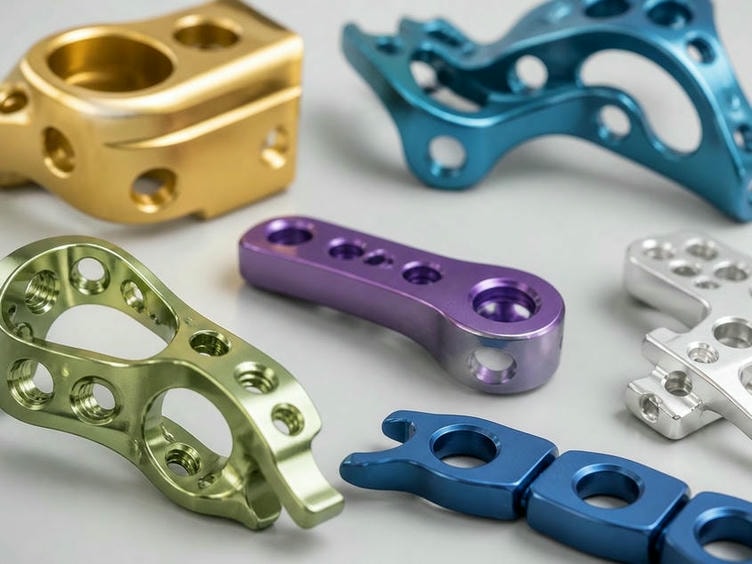
Color options support visual identification of different robot modules, assemblies, or branded components.
Material focus
Calibrated for 6061 and 7075 aluminum
Robotics designs rely heavily on these lightweight alloys. We adjust process control to their metallurgical properties for consistent results from prototypes through full production.
Aluminum 6061-T6
The industry standard for general robotics components. It responds well to both Type II and Type III anodizing, yielding high-quality, consistent finishes.
Aluminum 7075-T6
Used for high-strength, lightweight robot arm links and structural components. Its zinc content requires tighter control, so we monitor bath chemistry and temperature to reduce burning and uneven coating thickness.
Process control
Consistency engineered into every batch
When robot arm links and housings are sourced in batches, stable visual and physical properties are vital to efficient assembly.
Why it matters
Uniform anodizing supports repeatable fit, appearance, and performance across complex geometries.
Rack positioning
Optimized racking supports uniform current distribution and helps prevent shadowing or uneven color density on complex parts.
Bath maintenance
Chemical concentration, temperature, and agitation are monitored to support consistent oxide layer thickness.
Professional masking
Specified surfaces can remain free of anodizing where electrical conductivity or precise bearing fits are required.
Functional benefits
Protection designed for repetitive motion and demanding environments
Wear resistance
Type III hardcoat can create a surface hardness often exceeding that of the base aluminum for gripper fingers and pivot points.
Corrosion protection
A valuable protective layer for AMRs, AGVs, and outdoor service robots exposed to changing environmental conditions.
Electrical insulation
The anodized layer acts as a dielectric to provide electrical isolation for motor mounts and sensor housings.
Reduced friction
Sealed anodized surfaces can improve moving-part performance by reducing the coefficient of friction compared with raw aluminum.
Typical applications
Finishing for the parts that keep robots moving
Joint housings
Protecting precision bores and bearing seats against wear.
Robot arm links
Durable finishes for high-strength 7075-T6 structures.
Sensor and LiDAR mounts
Black anodizing helps minimize light reflection.
Gripper fingers
Hardcoat protection for high-cycle gripping operations.
Actuator casings
Protective finishes for internal motion-control mechanisms.
Quality assurance
Inspection and documentation that support traceability
Our quality control process verifies the anodized layer against your project specifications and quality management requirements.
Thickness verification +
Coating thickness is measured to ensure compliance with Type II or Type III standards.
Visual inspection +
Parts are checked for surface uniformity, color consistency, pitting, burning, and other visible defects.
Adhesion testing +
Testing verifies that the anodic coating is properly bonded to the aluminum substrate.
Documentation +
Certificates of Conformance and process reports are available upon request to support quality systems and traceability.
Request a quote
Send your anodized parts project for review
If you are developing robotics hardware and require precision CNC machining with professional surface finishing, our team is ready to review your project.
3D CAD model and 2D drawing: Specify anodized surfaces and any areas requiring masking.
Material specification: For example, 6061-T6 or 7075-T6.
Finish requirements: For example, Type II Black or Type III Hardcoat.
Quantity: Include prototype and production volumes where applicable.
Precision CNC Parts for Robotics & Automation
RobotPartsCNC
info@robotpartscnc.com
Tell us about your components
Share your drawings, alloy, finish, and quantity requirements with our engineering team.