
CNC Machining + Black Oxide Finishing
Black Oxide Finishing for Robotics CNC Components
RobotPartsCNC delivers precision-machined steel robotics components with integrated black oxide treatment. From prototypes to production runs, we supply finished, ready-to-assemble parts for demanding automation applications.
<0.0001 mm
Typical dimensional addition
3–5 Axis
Complex component machining
DFM Review
Fit and finish planning
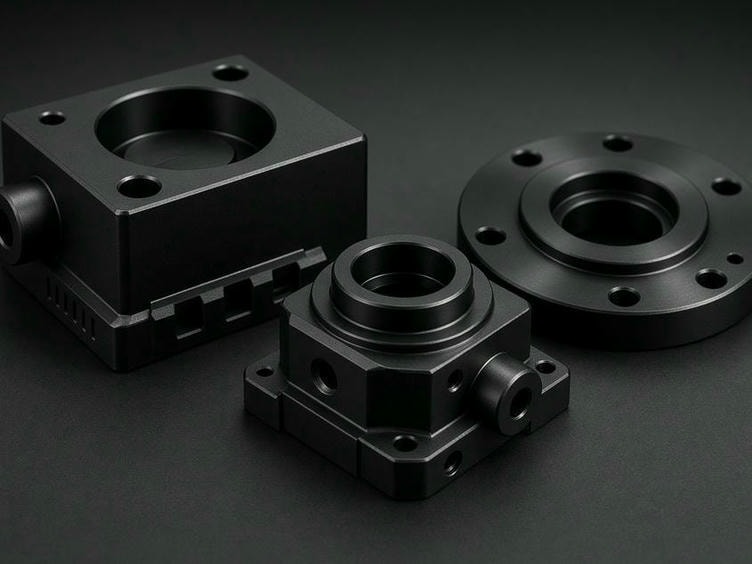
Built for precision assembly
Low dimensional impact helps preserve bearing fits, threaded holes, and tight-tolerance bores.
Why black oxide
A practical finish for precision steel robotics parts
Black oxide is a conversion coating for carbon and alloy steel. It creates a consistent black appearance while adding minimal thickness, making it well suited to components where fit, clearance, and optical behavior matter.
Dimensional stability
Typically adds less than 0.0001 mm, helping preserve press fits, slip fits, threaded holes, and precision bores.
Reduced glare
The low-reflection black appearance is useful near optical sensors, cameras, and LiDAR systems.
Corrosion protection
A light oil or wax post-treatment improves protection for indoor robotics, automation equipment, and controlled environments.
Efficient finish
A cost-effective way to improve the appearance, handling durability, and professional presentation of steel parts.
Integrated production
One manufacturing route from raw material to finished part
Our team coordinates machining, preparation, controlled batch treatment, oil sealing, and inspection to reduce handoffs and maintain consistency.
01
Precision CNC turning
For precision shafts, motor mounts, actuator housings, and rotating components.
02
3- to 5-axis milling
For complex robot arm links, structural components, brackets, and tooling.
03
Mill-turn production
Integrated setups reduce handling and help maximize concentricity on rotating parts.
04
Controlled finishing
Cleaning, degreasing, black oxide processing, and oil immersion support a uniform finish and corrosion protection.
Precision by design
Managing tolerances through the surface treatment
Black oxide has low dimensional impact, but fit, friction, sealing, and corrosion requirements still need to be planned into the part design.
Bearing fits
Critical bores and shafts are reviewed to maintain consistent press-fit or slip-fit assembly after treatment.
Thread integrity
Thread geometry and friction are considered so fasteners engage smoothly during final assembly.
Oil seals and corrosion control
Oil or wax selection is matched to storage and service conditions. Sealing surfaces and masking requirements are reviewed to avoid contamination or unwanted lubricant on mating areas.
Surface preparation
Thorough cleaning and degreasing help prevent blotching and deliver an even, deep black appearance.
Material compatibility
Steel grades selected for the application
1018 and 1045 carbon steel
Common choices for brackets, structural parts, mounts, and general automation components.
4140 and 4340 alloy steel
High-strength options for critical drive components, shafts, and robot joint mechanisms.
Tool steels
Suitable for high-wear gripper fingers, custom fixtures, and assembly tooling.
Typical applications
Black oxide parts for robotics and automation
We frequently treat steel components that combine precision geometry, low-reflection appearance, corrosion protection, and a professional black finish.
Actuator housings
Steel housings for gearboxes and reducers.
Precision shafts
Drive shafts and pivot pins for robot joints.
Mounting brackets
Structural steel brackets for automation equipment.
Gripper components
Hardened jaws and fingers requiring low reflection.
Fixtures and adapters
Custom tooling for assembly lines and EOAT.
Quality assurance
Traceable quality from inspection to documentation
Our quality team verifies the features and finish that matter to robotics assembly, supporting consistent performance across prototypes and production batches.
Dimensional verification
Critical features are checked before and after surface treatment.
Visual inspection
Batches are reviewed for uniform color, coverage, and finish consistency.
Quality records
CoC and material certifications are available according to project requirements.
Technical questions
What to consider before specifying black oxide
Will black oxide affect precision fits?
The dimensional addition is typically less than 0.0001 mm, but critical bores, shafts, threads, and mating surfaces should still be identified during DFM review.
Is black oxide suitable for outdoor exposure?
Black oxide provides mild corrosion resistance. Oil or wax improves protection, but harsh outdoor or continuously wet environments may require a different coating system.
How should oil sealing be handled?
The post-treatment oil or wax should match storage and service needs. We review sealing surfaces, cleanliness, masking, and any areas where lubricant could affect assembly.
What files are needed for a quote?
Send 3D CAD models, 2D drawings with critical tolerances, material and quantity requirements, and any inspection or certification requirements.
Start your project
Request a black oxide CNC machining quote
From a single prototype to large production runs, RobotPartsCNC supports fast-turnaround manufacturing and efficient international logistics from Shenzhen.
Please provide
- 1. 3D CAD models in STEP, IGES, or X_T format.
- 2. 2D PDF drawings showing critical tolerances and finish areas.
- 3. Material specifications and quantity requirements.
- 4. Inspection requirements such as CMM reports or material certifications.
Send your requirements
Our team will review your drawings, finish requirements, and assembly considerations.